
Press release
21.09.2026
The Vote to Freedom
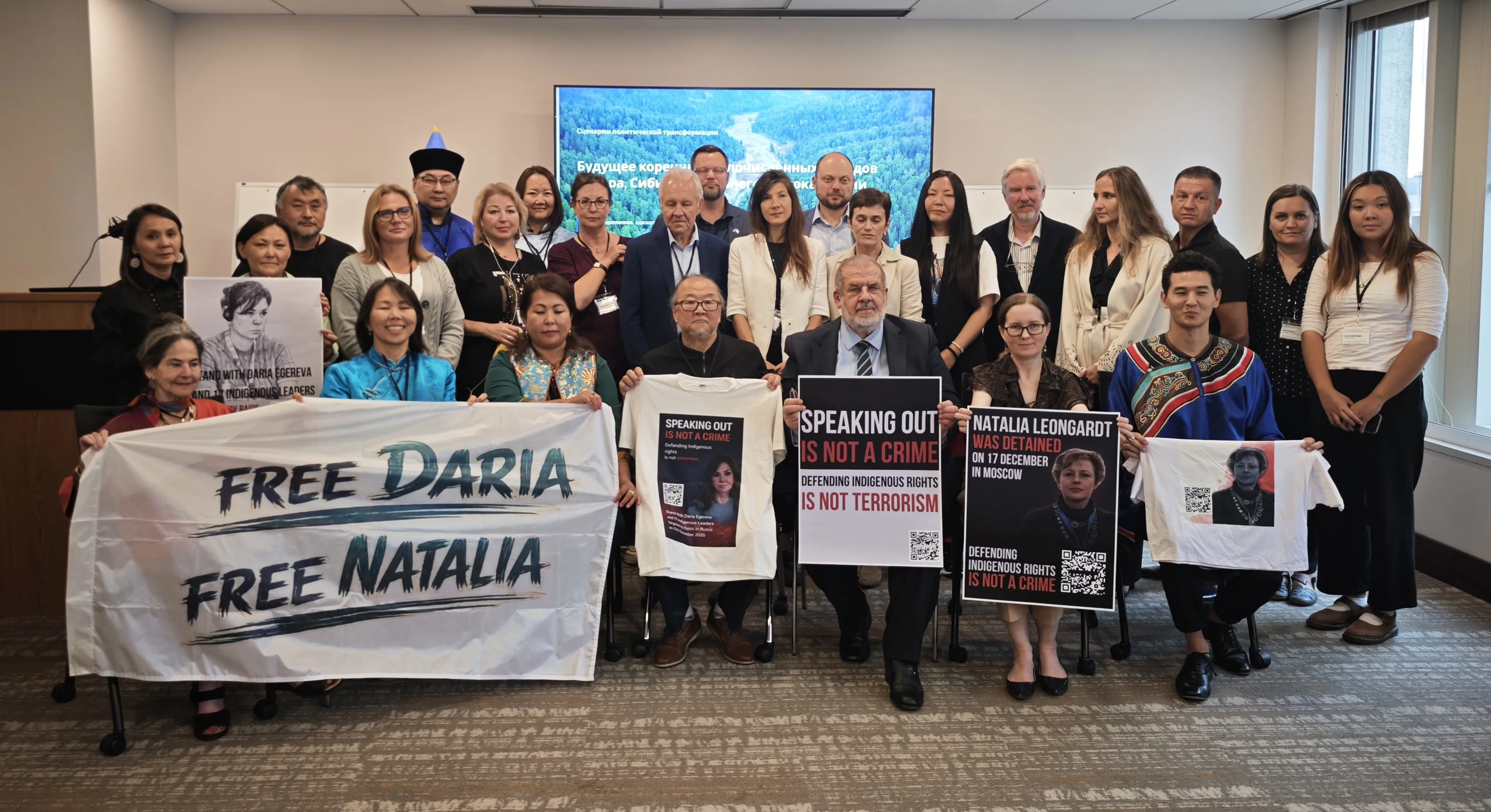
Representatives of Russia’s Indigenous Peoples and the Russian opposition spoke out against the election results and demanded the unconditional release of Daria Egereva and Natalia Leongardt in a joint statement.
Today, “United Russia” won the latest round of illegitimate elections in Russia—an event marked by numerous recorded violations and the absence of any party opposing the war, following the disqualification of the “Yabloko” party. Meanwhile, estimates suggest that between 5,000 and 11,000 political prisoners remain behind bars in Russia. Among them are Daria Egereva and Natalia Leongardt; they have been held in pre-trial detention for 278 days on terrorism charges stemming from their work defending the rights of Russia’s small-numbered Indigenous Peoples.
At a meeting held by the Navajo Nation Washington Office titled “The Place of Indigenous Peoples of the North, Siberia, and the Far East in Modern and Future Russia,” representatives of Indigenous Peoples of Russia and the Russian opposition adopted two resolutions:
1) condemning the repression of Russia’s Indigenous Small-numbered Peoples;
2) rejecting the legitimacy of the elections to the Russian State Duma.
Participants in the meeting included:
• DeWayne Crank, Deputy Executive Director of the Navajo Nation Washington Office
• Pavel Sulyandziga, representative of the Udege people, President of the Batani Foundation
• Petra Bayr, President of PACE
• Mariana Katzarova, first UN Special Rapporteur on the situation of human rights in the Russian Federation
• Vladislav Inozemtsev, Council member of the Free Russia Forum, Doctor of Economics
• Vladimir Kara-Murza, Vice President of the Free Russia Foundation, Russian politician
• Refat Chubarov, Chairman of the Mejlis of the Crimean Tatar People
• Olga Prokopieva, Deputy Chair of the Peaceful Russia party
• Leslie Esparza, representative of Microsoft
• Elena Lukyanova, member of the Anti-War Committee, Doctor of Historical Sciences, head of the Free University
• Irina Busygina, scholar and leading expert on federalism, Harvard University
QUOTE SHEET:
DeWayne Crank, Deputy Executive Director of the Navajo Nation Washington Office:
“I acknowledge the peoples historically connected to the territory of present-day Washington, D.C., and the surrounding areas, including the Nacotchtank and Piscataway. There are two important concepts in Navajo culture: *K’é*, signifying kinship and interconnectedness, and *Hózhó*, associated with harmony, beauty, and well-being. I hope you will make these principles the
foundation of your dialogue, and I wish the participants wisdom in their words, mutual respect, and progress toward a shared goal.”
Petra Bayr, President of PACE:
“I urge you to speak about Indigenous Peoples not merely in terms of discrimination, exclusion, and marginalization—for these concepts describe what has been done to people, not who Indigenous Peoples themselves are. Recalling my trip to Kamchatka some twenty years ago: traditional clothing, music, dance, and crafts are not just cultural attributes, but forms of preserving and transmitting knowledge. A river, a forest, or a stretch of tundra can simultaneously embody identity, ancestors, spirituality, community, and an obligation to those yet unborn. Language is of particular importance. When a language disappears, we lose more than just vocabulary; we lose one of the ways humanity has of understanding itself.”
Pavel Sulyandziga, representative of the Udege people and President of the Batani Foundation:
“This meeting is taking place at a difficult time for the independent movement of Russia’s indigenous peoples. It is a particularly trying time for the indigenous small-numbered peoples of the North, Siberia, and the Far East—a time of repression against independent leaders and activists. Right now, Daria Egereva and Natalia Leongardt are in custody, accused by Russian authorities of participating in a terrorist organization. The charges against them are fabricated and unlawful!”
Vladislav Inozemtsev, Council member of the Free Russia Forum and Doctor of Economics:
“One cannot ignore the outrageous injustice inflicted upon Russia’s Indigenous Peoples—both in centuries past and in recent years. As a result of industrial expansion, these people have lost their history, their identity, and the lands where they sustained their livelihoods—lands that gave them the strength to be who they are. These are the devastating consequences of Russian and Soviet assimilation policies. Therefore, the Russian democratic movement cannot disregard the views of these people!”
Vladimir Kara-Murza, Vice President of the Free Russia Foundation and a Russian politician:
“The theme of free peoples resonates deeply with me on a personal level; I myself am of five different nationalities. Our country is home to more than 190 peoples, nationalities, and ethnic groups—this is a tremendous asset. It is an asset that, today, is not merely left untapped but is—at best—ignored, and—at worst—undermined by the current regime; this is something we must completely change for Russia’s future!”
For media inquiries please contact:
Solidarity Campaign Media Coordinator
Signal – @solidarity.88