
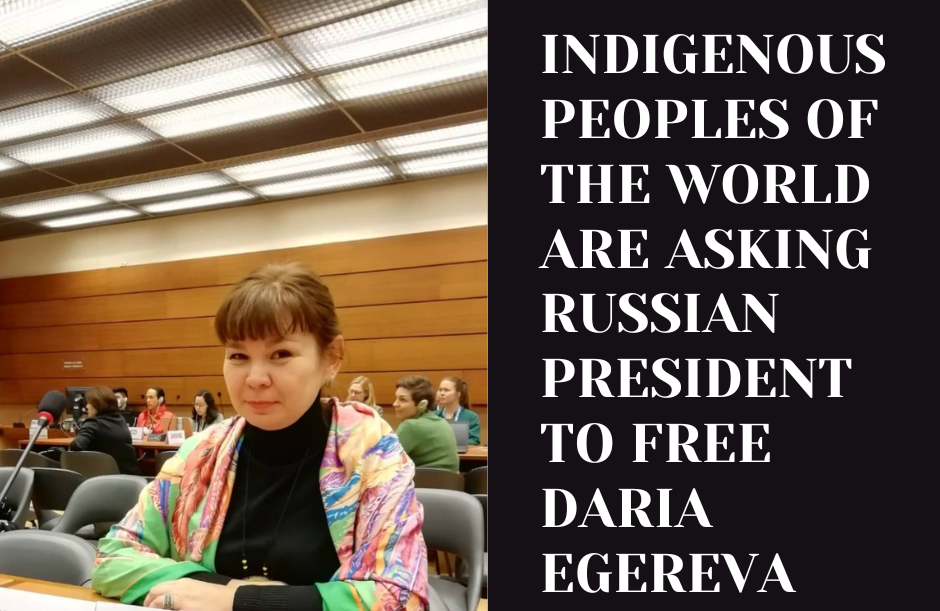
09 February 2026
President Vladimir Vladimirovich Putin
The Kremlin, Moscow
Russian Federation
Dear Mr. President,
We address you on behalf of Indigenous Peoples from the seven United Nations socio-cultural regions, as well as the organizations and institutions that, over many years, have engaged in sustained partnership with Ms. Daria Egereva within the United Nations’ international processes.
Ms. Egereva is a representative of the Selkup, one of the smallest Indigenous Peoples in Russia with a total population of 3500, and has, over a sustained period, undertaken professional responsibilities addressing the participation of Indigenous Peoples in multilateral processes. Her work has focused on global climate cooperation and on facilitating structured dialogue between Indigenous Peoples and States within official United Nations frameworks, including those in which the Russian Federation participates.
During her professional engagement as a technical expert on climate change, Ms. Egereva carried out coordination and facilitation functions within international forums. In particular, she held leadership roles within the official Indigenous Peoples Constituency, also known as the International Indigenous Peoples Forum on Climate Change (IIPFCC). The IIPFCC supports the coordination of Indigenous Peoples from the seven UN socio-cultural regions within the UN Framework Convention on Climate Change (UNFCCC) process. In her capacity as Co-Chair of the IIPFCC, she participated in COP28 in Dubai (United Arab Emirates), COP29 hosted in Baku (Azerbaijan), within the Eastern Europe, Russia, Central Asia, and Transcaucasia region, and COP30 in Belém (Brazil). In these contexts, her work contributed to constructive, respectful, and peaceful dialogue between Indigenous Peoples and State delegations. Her role was strictly coordinative and facilitative in nature, supporting orderly engagement within official negotiation processes.
In addition, Ms. Egereva served as a member of the Facilitative Working Group of the Local Communities and Indigenous Peoples Platform (LCIPP) under the UNFCCC. In this role, she contributed to technical and consultative deliberations aimed at strengthening structured, transparent, and effective engagement between States and Indigenous Peoples in the formulation and implementation of climate policy. This engagement was solutions-oriented, collaborative, and mutually respectful.
Ms. Egereva also participated in the work of the United Nations Expert Mechanism on the Rights of Indigenous Peoples (EMRIP) and the United Nations Permanent Forum on Indigenous Issues (UNPFII), where she provided expert input and engaged in consultative processes conducted in accordance with the respective mandates of these United Nations bodies.
Across all these international processes, Ms. Egereva’s activities were exclusively professional, non-violent, and institutional in nature, firmly grounded in dialogue and cooperation, and conducted in full accordance with officially recognized procedures.
We are aware that Ms. Egereva is currently held in custody in connection with criminal proceedings in the Russian Federation. We express our concern that Ms. Egereva was detained by Russian authorities within days of her return to Russia from the UNFCCC COP30 in Belém, Brazil. Her detention undermines confidence that Indigenous Peoples are able to fully participate in recognized international and United Nations processes without fear of retribution.
We do not question the competence of the relevant State authorities. At the same time, in light of the nature of her professional activities and the circumstances described above, as well as her familial obligations as a mother, we respectfully request her release, taking into account the professional and consultative character of her participation in international processes.
We express our sincere hope that the decision taken will contribute to maintaining confidence in constructive international engagement, while reaffirming a commitment to the principles of human dignity, proportionality, and peaceful, professional dialogue, as reflected in internationally recognized human rights standards.
Please accept the assurances of our highest consideration.
Respectfully,
Indigenous Caucuses (made up of the seven UN socio-cultural regions)
International Indigenous Peoples Forum on Climate Change
International Indigenous Peoples Forum on Mercury
International Indigenous Peoples Forum on World Heritage
International Indigenous Peoples Forum on Plastics
Indigenous Peoples Major Group for Sustainable Development
UNEP–Indigenous Peoples Major Group
Regions
African Indigenous Peoples Caucus on Climate Change
African Indigenous Peoples Regional Caucus on the Convention to Combat Desertification
African Indigenous Peoples Caucus on the Convention on Biological Diversity
Arctic Indigenous Peoples Caucus
Asia Indigenous Peoples Caucus on Climate Change
North America Indigenous Peoples Working Group on Climate Change
Latin America and Caribbean Indigenous Peoples Regional Caucus
Indigenous Organizations
Alliances of African Pastoralist Forums (Africa)
Asociación de Mujeres Abogadas Indígenas, (AMAI) (LAC)
Asian Indigenous Peoples Network on Extractive Industries and Energy (Asia)
Chhattisgarh Tribal People’s Forum (Asia)
Common Threads Indigenous Peoples Organization (Pacific)
Comunidades Indígenas Mangaba, Cajueiro I, Cajueiro II, Lagoa dos Mabaços, Acuipe Do Meio e Acuipe de Baixo (LAC)
Continental Network of Indigenous Women of the Americas (ECMIA) (LAC)
Coordination of Indigenous Organizations of the Brazilian Amazon (COIAB) (LAC)
Federación Indígena Empresarial y Comunidades Locales de México (CIELO) (LAC)
Foro Indígena Abya Yala (FIAY) (LAC)
FSC-Indigenous Foundation (Global)
IPREBAD (Africa)
Indigenous Peoples Rights International (IPRI) (Global)
Indigenous World Association (Global)
Oceania Human Rights (Pacific)
Ogiek Peoples Development Program (OPDP) (Africa)
Organización Líderes Del Futuro Ngäbe Buglé (OLINABP) (LAC)
Plataforma Boliviana Frente al Cambio Climático (LAC)
Porgera Landowners Association, Papua New Guinea (Pacific)
Sarawak Dayak Iban Association (Asia)
Unidad de la Fuerza Indígena y Campesina (UFIC) (LAC)
Wahkohtowin Development (NA)
Annex 1. Ms. Daria Egereva Profile of International Engagement
- Identity and Background
- Representative of the Selkup Indigenous People of the North, Siberia and Far East recognized by the Russian Government.
- Citizen of the Russian Federation.
- Long-standing participant in international consultative processes related to Indigenous Peoples and climate policy.
- International Indigenous Peoples Forum on Climate Change (IIPFCC)
- Served in leadership roles within the IIPFCC.
- Act as Co-Chair of the IIPFCC.
- Participated in United Nations Framework Convention on Climate Change (UNFCCC) Conferences of the Parties: COP28 (Dubai), COP29 (Azerbaijan – Eastern Europe, Russia, Central Asia and Transcaucasia region), COP30 (Belem, Brasil)
- In this capacity, performed facilitative and coordinative functions aimed at:
- Supporting orderly participation of Indigenous representatives.
- Promoting respectful and peaceful dialogue between Indigenous Peoples and State delegations.
- Contributing to structured engagement within official UNFCCC processes.
- Local Communities and Indigenous Peoples Platform (LCIPP) – UNFCCC
- Member of the Facilitative Working Group of the LCIPP.
- Participated in technical and consultative discussions.
- Contributed to the development of structured mechanisms for engagement between States and Indigenous Peoples within the UNFCCC framework.
- United Nations Expert Mechanism on the Rights of Indigenous Peoples (EMRIP)
- Participated in sessions and consultative activities of EMRIP.
- Contributed expert input within the scope of EMRIP’s mandate.
- Engagement focused on Indigenous participation, dialogue, and implementation of UN standards through consultative means.
- United Nations Permanent Forum on Indigenous Issues (PFII)
- Participated in sessions of the PFII.
- Engaged in consultative exchanges within the framework of PFII’s advisory mandate.
- Participation was professional and non-advocacy in character, consistent with PFII procedures.
- Nature of Activities
- All international activities were:
- Conducted openly and transparently.
- Non-violent and consultative in nature.
- Carried out within officially recognized United Nations processes.
- Activities were professional and facilitative, not political or confrontational.
- All international activities were:
- General Assessment
- Ms. Egereva’s international engagement was consistently institutional in character.
- Her roles focused on coordination, facilitation, and dialogue.
- No activities involved or promoted violence, extremism, or actions contrary to international procedures.