In April 2026, the UN Permanent Forum on Indigenous Issues will convene in New York. RAIPON will be there — speaking in the name of Indigenous Peoples of the Russian Federation.
But the world must understand what kind of representation is arriving.
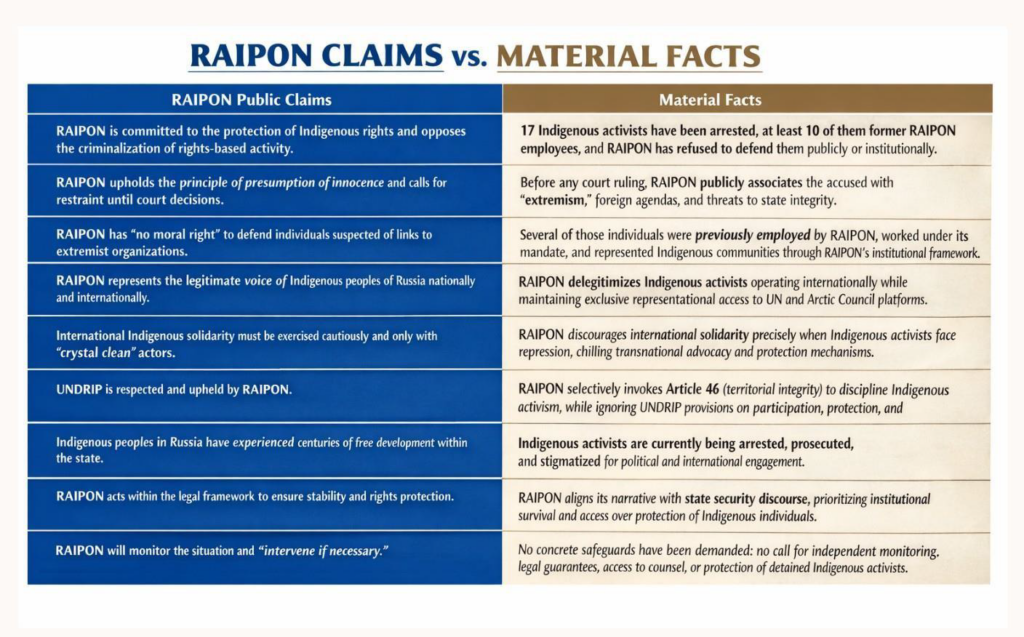
Months earlier on 17 Dec 2025, seventeen Indigenous human rights activists were arrested in Russia. At least ten of them are former RAIPON staff and members — people who once worked inside the organization, carried its mandate, represented communities, and implemented its programs.
For a full month, RAIPON remained silent.
There was no public statement. No expression of concern. No appeal for due process. No acknowledgment that Indigenous Peoples — its own constituency — were being detained for civic and environmental activism. RAIPON did not defend them. RAIPON did not demand safeguards. RAIPON did not insist on transparency, legal protection, or independent monitoring.
Instead, RAIPON publicly declared that it has “no moral right” to stand with them.
An Indigenous organization does not exist to perform loyalty in moments of danger. It exists to protect Indigenous Peoples when the cost of protection is high. When an organization disowns indigenous activists — before any court ruling — it is no longer practicing representation. It is practicing institutional survival through sacrifice.
RAIPON’s position reveals a deeper truth that the international system must confront: Indigenous rights are being reframed as conditional – on legality defined by the state, on political loyalty, on silence during repression, on not mobilizing international solidarity. Those who cross an invisible line lose legitimacy, protection, and voice — even when they once served the very institution that now disowns them.
This is managed Indigeneity.
RAIPON invokes the UN Declaration on the Rights of Indigenous Peoples — not to defend Indigenous activists, but to discipline them. A Declaration written to protect Indigenous Peoples from state power is being used to justify distance from Indigenous Peoples targeted by that power. When UNDRIP is used this way, it ceases to be a human rights instrument and becomes a tool of governance.
When RAIPON takes the floor at the UN Permanent Forum, one question must be asked — quietly or publicly, but unmistakably: If representation does not react to repression, what exactly is being represented?
If Indigenous organizations can retain UN consultative status, speak in global forums, and claim legitimacy, while refusing to defend peoples it vowed to protect – then the crisis is not only national; it is international.
The UN Permanent Forum is a global venue created because states cannot be the sole arbiters of Indigenous legitimacy. When RAIPON reaches the United Nations, the question is no longer whether Indigenous rights are under threat — but whether international institutions are willing to recognize capture when it stands at the podium.
What kind of representation survives by staying silent?